
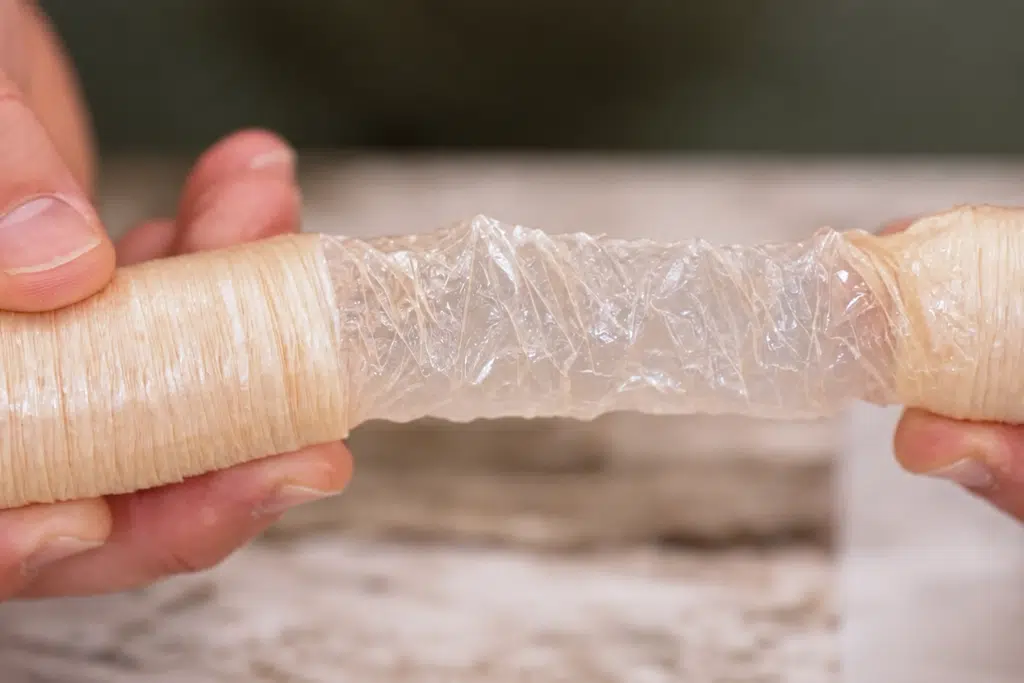
Collagen casings are widely used in modern sausage production because they provide a consistent and practical alternative to traditional natural casings. But what are collagen casings actually made of?
A collagen casing is primarily made from animal-derived collagen, a structural protein naturally found in skin and connective tissues. During manufacturing, collagen-rich raw materials are cleaned and processed, the collagen is prepared into a workable mass, and the material is then formed into continuous tubular sausage casings.
Understanding the materials and manufacturing process behind collagen casings can help sausage manufacturers select the right casing for different production requirements.
What Is a Collagen Casing?
A collagen casing is a manufactured casing designed to hold meat mixtures during sausage filling and processing. Unlike natural casings, which are prepared directly from animal intestines, collagen casings are formed from processed collagen.
Because they are manufactured to defined specifications, collagen casings can be produced with controlled diameters, wall thicknesses, and mechanical properties. This makes them particularly suitable for commercial sausage production where consistent sizing and compatibility with filling equipment are important.
Collagen casings are available in different specifications for fresh, cooked, smoked, dry, and semi-dry sausage products.
What Are Collagen Casings Made Of?
-
Collagen from Animal Hides and Connective Tissue
The main material used to make collagen casings is collagen obtained from collagen-rich animal tissues. In commercial production, bovine and porcine materials are commonly used, although the exact source depends on the manufacturer and product specification.
Animal hides contain large amounts of structural collagen. Instead of being used in their original form, these collagen-rich materials are processed so that the collagen fibers can be separated, conditioned, and transformed into a material suitable for casing production.
For products such as beef collagen casing, bovine hides provide the collagen source. Buyers with specific requirements regarding animal origin, religious certification, or labeling should always confirm the raw material source with the supplier.
-
Other Ingredients and Processing Components
Collagen is the primary structural material, but a finished casing may also contain water and other permitted processing components. Depending on the casing type and manufacturer, ingredients such as food-grade coloring, preservatives, or structural and processing aids may be used.
There is no single formulation used for every collagen casing. An edible casing for fresh sausage, for example, may have different formulation and moisture requirements from a casing developed for dry or processed sausage.
For this reason, commercial buyers should evaluate individual product specifications rather than assuming that all collagen casings have the same composition.

How Are Collagen Casings Made?
Although individual manufacturers use different formulations and processing conditions, the general collagen casing manufacturing process includes raw material preparation, collagen conditioning, gel preparation, extrusion, drying, and packaging.
- Raw Material Preparation. Collagen-rich animal materials are selected, cleaned, reduced to a suitable size, and prepared for further processing. Unwanted materials are removed before the collagen is processed.
- Collagen Extraction and Conditioning. The raw material undergoes controlled treatment to separate collagen fibers from other tissue components. The collagen is then purified and conditioned to achieve suitable processing characteristics.
- Collagen Mass Preparation. The processed collagen is hydrated and blended into a uniform, workable mass. Controlling consistency at this stage is important because it influences subsequent casing formation.
- Extrusion and Forming. The collagen material is passed through specialized extrusion equipment and formed into a continuous tubular casing. Manufacturers can control parameters such as casing diameter and wall thickness according to the intended sausage application.
- Drying, Conditioning, and Packaging. The newly formed casing is dried under controlled conditions until the required moisture and mechanical characteristics are reached. It can then be cut or shirred into convenient formats and packaged for commercial sausage production.

Are Collagen Casings Edible?
Many collagen casings are edible, but not every collagen casing is designed to be consumed.
Edible collagen casings are commonly used for smaller-diameter sausage products where the casing remains on the product during consumption. Other collagen casings, particularly certain thicker or specialized casings used for dry sausage products, may be designed to be removed before eating.
Whether a collagen casing is edible depends on its formulation, thickness, intended application, and manufacturer specification. Sausage processors should therefore confirm the product specification rather than selecting a casing based on appearance alone.
Main Types of Collagen Casings
- Fresh Collagen Casings
Fresh collagen casings are generally designed for products such as fresh sausages, breakfast sausages, and similar products that do not undergo extended drying. They are typically formulated to provide suitable flexibility and handling during filling. - Smoked or Processed Collagen Casings
Collagen casings can also be designed for cooked or smoked sausage production. These products need sufficient strength and stability to withstand filling and subsequent thermal or smoking processes. - Dry Collagen Casings
Dry collagen casings are used for products such as dry sausages, semi-dry sausages, salami-type products, and snack sticks. They generally require different moisture and mechanical characteristics from fresh casings, and some versions may be non-edible.
How to Choose a Collagen Casing for Sausage Production
Choosing the right collagen casing for sausage production requires more than selecting a diameter. Manufacturers should consider the sausage type, whether the casing needs to be edible, the cooking or smoking process, filling equipment, required casing strength, and final product dimensions.
A casing designed for fresh sausage may not perform the same way in a dry sausage process, while equipment used for high-speed filling may require specific casing dimensions and mechanical properties.
For B2B buyers, confirming these requirements before ordering helps ensure that the casing matches both the finished sausage and the production line.
Choosing the Right Collagen Casing
Collagen casings begin with animal-derived collagen, but their final performance also depends on how the collagen is processed, formed, dried, and conditioned. Different sausage products therefore require different casing specifications.
For commercial sausage manufacturers, selecting the appropriate casing type, diameter, and processing characteristics is essential for consistent production. ZXCHEM supplies edible collagen casings for sausage applications in different specifications. Contact us for product information, samples, and sourcing support.
Request Collagen Casing Samples & Specifications
Sourcing collagen casings from China
When choosing a collagen casings supplier in China, compare the selected grade, batch certificate of analysis, traceability and performance in your application. Ask for a sample and clarify packaging and export documentation before ordering.
Contact ZXCHEM with your application and purchasing requirements. Where a factory or manufacturer is involved, confirm the actual production site and its role in the supply chain.