A dairy-free protein shake has to work in the shaker as well as on the specification sheet. Buyers may start with protein content, but the development decision also depends on mixing, flavour, texture and repeatable production.
Beef protein isolate (BPI) gives formulators a beef-derived option for ready-to-mix powders. ZXCHEM’s CollaBeef™ BP beef protein isolate powder is specified at a minimum of 90% protein. That concentration provides room to develop flavour and texture systems while working towards a defined protein target. The finished formula still needs its own trials.
Where beef protein isolate fits in dairy-free shakes
BPI is relevant when a product brief calls for an animal-source protein without relying on whey or other milk-derived proteins. It can be assessed for tubs, single-serving sachets and other dry shake formats.
Be clear about the ingredient identity. A beef-derived protein is not a plant protein, and beef protein isolate should not be treated as interchangeable with bone broth powder. The required composition, sensory profile and application determine which ingredient is appropriate. Our beef protein isolate overview explains the category alongside the product specification.
For a dairy-free product brief, review the full ingredient list, including flavour carriers and processing aids, as well as the manufacturing arrangements. Selecting the main protein is one part of that review.
Set the protein target before adjusting flavour
Start with protein per serving and a realistic total serving weight. Use the selected grade’s specification and confirm the basis of the declared protein result before calculating ingredient input.
For illustration, a shake targeting 20 g of protein would require about 22.2 g of an ingredient containing 90% protein, if that ingredient supplied all the protein. This is a formulation calculation, not a recommended serving size or a finished recipe. Other ingredients, manufacturing tolerances and final product testing must be considered.
Check how much space remains for cocoa, flavouring, sweeteners and any texture ingredients. If the serving size becomes impractical, revisit the brief before committing to a flavour system.
Test cold-water mixing under realistic conditions
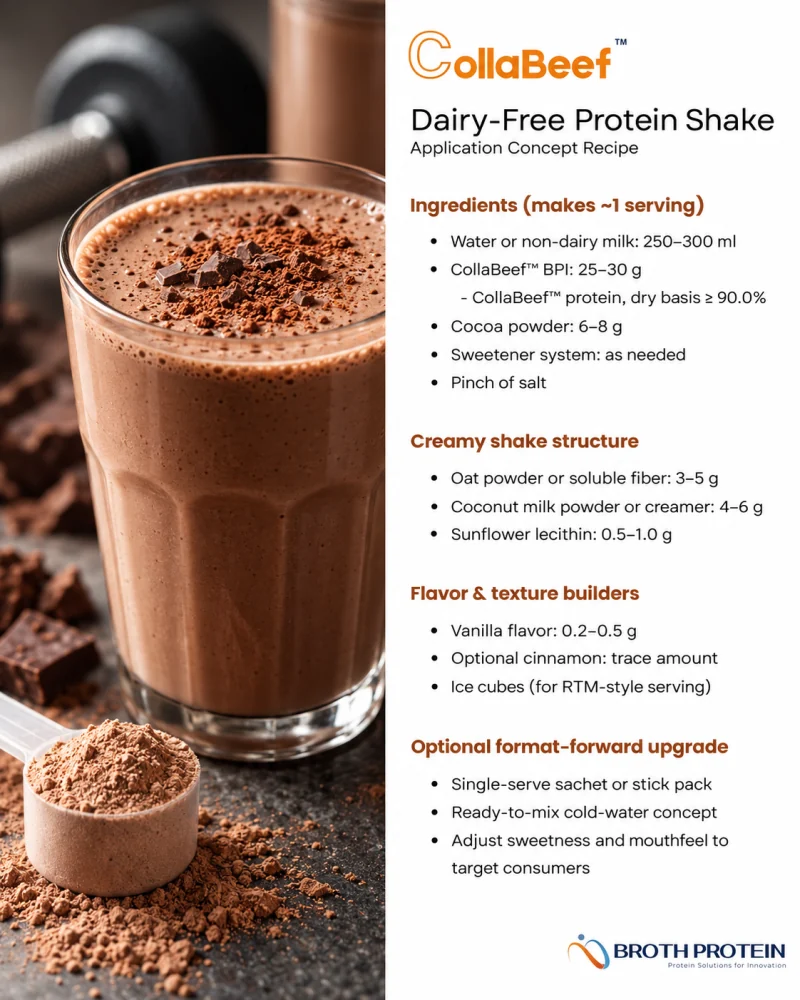
The source application article describes CollaBeef™ as designed for rapid cold-water dispersion. Confirm the mixing behaviour of the actual grade and batch in your complete formula. Dispersion in a simple protein-and-water test does not establish how a cocoa blend or a more complex shake will perform.
- Keep preparation consistent: record water temperature, liquid volume, powder addition order and mixing time.
- Use the intended preparation method: test a shaker if that is how the customer will prepare the drink.
- Inspect the whole drink: note wetting, lumps, foam, visible particles and sediment after standing.
- Repeat with the final blend: include all flavour and texture ingredients before accepting the result.
These records give purchasing, development and production teams a common basis for comparing samples.
Build flavour and mouthfeel together
Chocolate, vanilla and fruit-inspired shakes are useful development directions. They are starting points for sensory work, rather than evidence that one protein grade will suit every flavour.
Evaluate the protein’s characteristic taste in the finished drink. Review sweetness, aftertaste, thickness and sediment together; an adjustment that improves one attribute can change another. Compare samples prepared at the same serving weight and liquid volume, and document the formulation used for each trial.
Use pilot production to settle the purchasing specification
Before placing a commercial order, test the powder through the intended blending and filling process. A successful bench sample is a useful starting point; pilot production establishes whether the proposed process and pack format are suitable.
- Assess blend uniformity and handling during transfer and filling.
- Review fill-weight consistency for the selected serving format.
- Evaluate moisture protection and storage in the proposed packaging.
- Agree which incoming-material and finished-product checks will govern release.
The purchasing specification should identify the approved grade, protein requirement, relevant physical and microbiological parameters, packaging and document requirements. Compare that specification with the batch Certificate of Analysis (COA), rather than relying on a product name alone.
Prepare a useful sample and quotation request
Send the intended application, target protein per serving, preferred pack format, trial quantity and destination to ZXCHEM. Include any required testing or documentation so that the sample and quotation refer to the same material.
For broader formulation work, review our animal protein ingredients. To discuss the selected BPI grade, request specifications and sample arrangements.
Questions from formulation and purchasing teams
Can BPI replace whey in an existing recipe?
It can be evaluated as an alternative protein source, but a direct substitution should be tested. Recheck protein input, mixing, taste, texture and the complete ingredient declaration.
Does rapid dispersion guarantee a clear or sediment-free drink?
No. Dispersion, clarity and sediment are separate evaluation points. Confirm each in the finished formula under the intended preparation and standing conditions.
Which documents should accompany sample approval?
Keep the agreed specification, technical data and the sample’s batch COA with the trial results. Confirm that the later commercial order refers to the approved grade.
中文版本:阅读本篇中文指南
Adapted and expanded from Broth Protein’s dairy-free shake formulation article, with additional procurement and pilot-trial guidance. Images illustrate application concepts.